

The 15% Truth
What seed stage venture capital really looks like in 2026 — and why the reckoning has only just begun

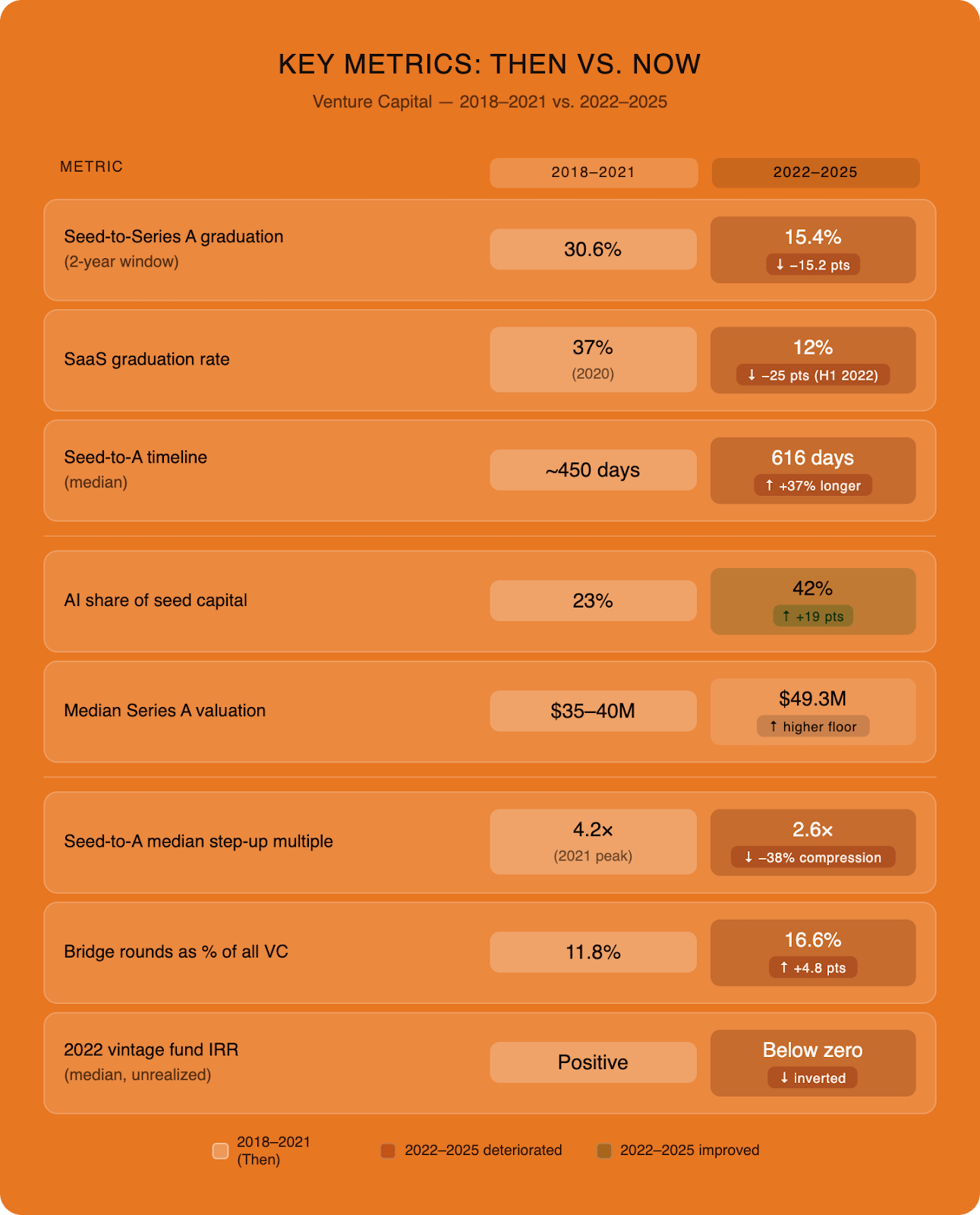
Here is the number that should end conversations at every seed stage pitch meeting, every LP update call, and every founder strategy session happening right now: 15.4%. That is the share of startups that raised a seed round in Q1 2022 and successfully graduated to a Series A within two years, according to Carta’s State of Private Markets data. Only four years earlier, in 2018, that same figure was 30.6%. In 2021, during the peak of the low interest rate frenzy, more than half of seed cohorts from 2019 were making it through. The halving of the graduation rate is not a coincidence. It is a structural change, and almost no one in the market is weighing the consequences.
The venture capital industry in 2026 is operating in two entirely different realities depending on whether you are building with artificial intelligence or without it. If you are in the former camp, valuations are setting records, check sizes are swelling, and the headlines look euphoric. If you are in the latter, you are navigating the most selective early-stage funding environment in more than a decade. Both things are simultaneously true, and the tension between them defines everything about how capital flows, or why it stalls now.
This piece is not an indictment of the industry. It is a challenge to founders and investors alike to interrogate their own assumptions before they deploy another dollar or sign another term sheet. The data makes clear that the playbook most people are still running was written for a market that has drastically changed.
More Money Into Fewer Companies
The headline numbers for venture capital in 2026 look almost triumphant. Total venture funding is on pace to exceed $120 billion for the year, up from roughly $97 billion in 2024. Global funding through the first half of 2025 alone hit $205 billion (up 32% year-over-year) and had the strongest half-year since early 2022, per Crunchbase. Two of the largest single venture financings ever recorded occurred last year: Scale AI’s $14.3 billion round in Q2 2025 and OpenAI’s staggering $40 billion raise in Q1. These are generational capital events. They are also deeply misleading as indicators of health for anyone operating below the late or mega-cap stage.
Strip away these huge rounds, and the picture inverts. Seed deal count was down 10 to 13 percent year-over-year through 2025. In Q1 2025 specifically, Carta tracked just 401 seed rounds — a 28% decline from the same quarter a year prior — with $1.2 billion raised, down 37%. The venture industry is not growing uniformly. It is concentrating, consolidating, and bifurcating in ways that make aggregate statistics almost useless as a guide to what founders and early-stage investors are actually experiencing on the ground in the U.S.
Cambridge Associates captured the structural problem precisely in its 2026 venture outlook: more than 4,200 venture funds have been raised in the United States since 2022, with 42% of 2024 vintage funds classified as micro-funds in the $1 million to $10 million range. This number is way up from just 25% in 2020. More funds, same number of breakout companies. The math is unforgiving.
Too Many Seeds, Not Enough Series A
Crunchbase data illustrates what practitioners have nicknamed “the Orange Crush” problem: over the past few years, seed round volume has grown by approximately 33% while the number of Series A rounds has declined by nearly 10%. What was a roughly 1:1 ratio of seed to Series A deals in 2008 has steadily deteriorated to approximately 2:1, and this gap continues to widen. You now have an ecosystem with roughly double the number of seed-funded companies competing for the same number of institutional Series A slots that existed a decade ago.
The median time between seed and series A has stretched to 616 days as of Q2 2025, which is more than 20 months and roughly two months longer than just two years prior, per Carta data. Series A investors have responded to the glut of candidates by raising their proof-point thresholds substantially. Revenue trajectory, repeatable sales motion, unit economics discipline, and team stability are no longer differentiators at this stage; they are the bare minimum.
“Only companies with the strongest competitive positions are attracting substantial funding. Investors are prioritizing companies with strong unit economics, growth, and defensible market positions.”
— Wellington Management, Harvard Law School Forum on Corporate Governance, December 2025
For founders, 18 months felt like a long runway in 2021. In 2026, it is a liability. Building for 24 to 36 months of capital is not paranoia; it is the new baseline for anyone who wants optionality in their fundraising process. The bridge round surge tells the story plainly: bridge financings now represent 16.6% of all venture capital deployed in Q2 2025, up from 11.8% a year prior. Many companies are not bridging from strength. They are bridging from desperation, extending SAFE agreements to buy time for milestones that institutional investors keep moving further out of reach.
Fear, Greed, and the 42% Premium
Let us be direct about what is happening with AI and venture capital: it is both the most rational allocation decision in the industry right now and a source of serious malinvestment risk. Those two things coexist, and shifting them in either direction by dismissing the AI opportunity or surrendering all critical thinking to the hype, is how both founders and investors lose money over the next cycle.
The rational case is formidable. PitchBook data shows AI startups captured 65% of all US venture deal value through Q3 2025, with more than half of all new unicorns built on AI innovation. The median age at first financing for AI startups is 65% lower than that of non-AI peers, meaning these companies are raising capital faster and progressing through rounds more quickly. This could also be a signal that AI companies At our seed stage specifically, AI companies command a 42% valuation premium over their non-AI counterparts. In the 95th percentile of seed rounds, post-money valuations have hit $80.5 million. This figure would have been mid-Series A territory just four years ago. At High Street, this growth in seed round valuations depletes the number of deals we can consider at our sweet-spot valuation of under $15 million.
The irrational case is also visible if you look. QED Investors, in their 2026 predictions, put it bluntly: “From the smallest local pre-seed fund to the largest megafund, VCs are people with a hammer seeing the whole world’s problems as AI nails. Though hints of skepticism have snuck back into whispers, without a core AI story it feels nearly impossible for a company to get funded. This has led to malinvestment, particularly at the earliest high-risk stages, where funds that previously would take fliers on non-consensus deals crowd into ‘also-ran’ AI companies.”
The AI Veneer Problem
Investors who cannot distinguish between genuine AI-native architecture and a traditional SaaS product with a GPT wrapper are making the same mistake that LPs made with “mobile-first” companies in 2012 and “blockchain-enabled” companies in 2018.
The category label is not the moat. The data advantage, proprietary training pipeline, switching costs, or network effect is the real moat. Diligence on this distinction will separate this cycle’s winners from its write-offs.
One investor quoted by Crunchbase framed the structural risk clearly: “The competition is not between AI and a business process outsourcing contract. It’s between two AI companies. VCs are missing the power of competition to drive margin down in the age of AI.”
The sector-specific data shows both extremes in sharp relief. Gaming companies represent the cautionary tale of the current environment: only 2.3% of gaming startups that raised seed in Q1 2022 made it to Series A within two years, per Carta. For traditional SaaS, the graduation rate collapsed from 37% in 2020 to a measly 12% by 2022. These are not marginal declines. They are category-level capitulations that should be informing how fund managers construct their portfolios right now.
Last Cycle’s Bets Aren’t Paying Off
Perhaps the most consequential and least discussed factor of the current environment is what is happening inside the funds that deployed heavily during 2021 and 2022. The short version: it is not good, and the timeline to resolution is longer than most LPs have been told.
Carta’s fund performance data shows the median unrealized IRR for 2021 and 2022 vintage funds remains below zero. Only 37% of 2019 vintage funds and 30% of 2020 vintage funds had made any distributions to LPs whatsoever by Q1 2025. These are not distressed outlier funds. These are representative data points across the industry’s most active deployment years. Meanwhile, 2022 vintage funds had deployed only 43% of their committed capital by the 24-month mark — the lowest deployment rate on record.
The downstream effect of this distribution drought on the seed stage is significant and underappreciated. Cambridge Associates noted that LPs are increasingly entering the secondary market as first-time sellers, with continuation vehicles estimated to represent at least 20% of distributions in 2026. Secondary special purpose vehicles surged 682% from 2023 levels through 2025. Liquidity is not returning through the traditional IPO and M&A channels quickly enough, and the alternative plumbing being built to compensate for that shortfall represents a fundamental shift in how the venture asset class delivers returns.
“The private for longer dynamic compounds the challenges facing current seed-stage investors. As average hold periods extend, and the bar to go public or achieve significant M&A becomes more elevated, winners may become rarer and more consequential for the asset class.”
— Cambridge Associates, 2026 Venture Capital Outlook
The concentration of LP capital into the largest firms adds another layer of structural pressure. Panelists at Startup Boston Week 2025 noted that 90% of all venture capital raised over the prior two years flowed to just three firms — Andreessen Horowitz, General Catalyst, and NEA. The implication for micro-funds and emerging managers is stark. Not only are they competing for the same deals as multi-billion-dollar platforms with brand advantages and deep portfolio networks, they are doing so at a moment when their own fundraising environment has become materially harder.
What Winning Looks Like Now
If the old playbook was “raise seed, raise Series A, raise Series B,” what replaces it? The honest answer: several different things, depending on the company. The venture industry’s most important intellectual task over the next 12 to 24 months is expanding its definition of a successful outcome beyond the Series A graduation event that the entire ecosystem has been optimized around.
Among the 15% that do graduate to Series A, we’ve noticed a consistent profile. Carta data shows these companies typically display the following traits:
$100,000 to $500,000 in MRR
Strong trajectory, with 10% month-over-month growth a common threshold
Retention curves leveling at 80% or higher
Evidence of inbound demand signals & genuine product-market fit versus pure sales intensity
Sales motion must be repeatable without the founder in the room
For the 85% that will not graduate on the traditional timeline, the conversation needs to shift earlier. The most forward-thinking seed funds are already building frameworks for three distinct outcomes: Series A graduation, acquisition by a strategic buyer or private equity, and sustainable revenue business with no further institutional funding. That third option has been treated as a failure mode by the venture industry for years. In the current environment, it may increasingly represent rational capital allocation.
Visionary Shift
A growing number of seed managers are quietly repositioning around “optionality investing” — deliberately constructing portfolios where some percentage of companies are underwritten for Series A graduation, some for acquisition or strategic M&A, and some for capital-efficient revenue growth with no further dilution.
This trimodal outcome model requires different deal terms, different milestone frameworks, and different investor-founder conversations from day one. Though, it may be the most honest response to a graduation rate that is structurally settling around 15%.
Service-as-Software is also reshaping the addressable market calculus. PitchBook notes that enterprise software is shifting from seat-based SaaS to outcome-based models — a development that changes how TAM is sized and how revenue compounds at early-stage AI companies in ways that most traditional seed underwriting models have not yet accounted for.
Defense-tech and robotics are emerging as categories where the hardware cost curves and procurement visibility have finally converged in ways that make early-stage bets more underwriteable than at any point in the past decade.
WHAT FOUNDERS AND INVESTORS MUST RECKON WITH
Six Risks That Define the Next 12 Months
1. The solo founder surge is a due diligence gap.
Thirty-five percent of startups incorporated in 2024 had solo founders, a growing trend & more than double the rate from 2015, per Carta. Yet, only 17% of VC-backed companies are solo founded, meaning investors are systematically discounting solo teams at the point of institutional investment. More troubling is the co-founder attrition data: roughly one in four VC-backed two-founder teams loses a co-founder within four years, with that rate climbing to 35 to 40% by years six through eight. Teams that appear to satisfy the co-founder preference filter are more fragile than the statistics suggest.
2. The valuation gap between AI and everything else is creating a dangerous selection effect.
When 42% of all seed capital flows to AI companies and the 95th percentile of seed valuations touches $80.5 million, founders in every sector are being incentivized to attach AI narratives to products that may not fundamentally benefit from them. This is the growing “AI veneer” problem where a large portion of companies will face brutal renegotiations at Series A when institutional investors apply real revenue and retention scrutiny.
3. Geographic concentration is a structural disadvantage not adequately priced.
Pre-seed capital flows 38.4% to California startups, with the Bay Area, New York, Boston, Los Angeles, and Washington, D.C. dominating the distribution map. European founders face an even steeper climb: EU seed graduation rates are approximately 30% lower than US rates, with only about 11% making it to Series A by the same two-year window.
4. The down round risk has not disappeared.
Down rounds represented 17% of all rounds in Q3 2025, technically the lowest level in three years. But this follows a period in which down rounds exceeded 20% for seven of eight consecutive quarters from 2023 through Q1 2025. Median seed-to-Series A step-up multiples have compressed from 4.2x at the 2021 peak to 2.6x today, a 38% decline that mathematically reduces the room investors have to generate fund-level returns.
5. The bridge round normalization is masking a zombie company problem.
Bridge financings rising to 16.6% of all venture capital is not inherently alarming. The concern is that when bridge rounds are growing as a share of total capital deployed while the number of underlying deals is declining, it suggests that a meaningful portion of the seed ecosystem is in extended survival mode. This ends up burning through additional capital while waiting for a Series A environment that may not materialize on their timeline.
6. The power law is becoming more concentrated, not less.
Cambridge Associates cautioned that “missing” power law winners can result in a venture program that underperforms expectations across an entire fund cycle. Given that today’s IPO-ready companies require median trailing twelve-month revenue of over $500 million and 31% growth rates to access public markets, the probability that any given seed investment represents a company that can reach that threshold is genuinely small. The math of the asset class has always required power law outcomes. What has changed is how many funds are competing for the same small number of companies that might generate them.
High Street’s Advantage in this Market
In this changing landscape, High Street is actively navigating these risks. We pride ourselves in running a fund that only invests when our team can add real value. We also diversify across emerging tech, future of work, and digital health, which shows we only pay the AI premium in sectors where we see long-term advantages. We also apply many of the winning profile filters to our thesis as we ensure our portfolio companies have proprietary data, high retention, and crystal clear product-market fit. By exploring underserved regions and betting on underrepresented founders, we also have an advantage because High Street avoids competing in overinflated areas or deals based in hype. This allows us to block out the noise and treat every deal the same as it runs through our diligence process.
In a 15% market, you engineer success through quality instead of investment volume. Most seed funds built their models on abundance and are now facing harsh reality. We built our fund for a different thesis, and the current market is highlighting our strengths.
✦ ✦ ✦
The venture capital industry does not have a capital problem in 2026. It has a clarity problem. There is more money in the ecosystem than at almost any point in history, and yet it is flowing through narrower channels toward fewer companies, in fewer sectors, in fewer geographies. The funds that will outperform over the next decade are not the ones that identified AI as important. By now, everyone has done that. It’s likely the ones that built genuine frameworks for distinguishing the 15% from the 85% before the Series A process makes that answer obvious.
For founders, the implication is straightforward even if the execution is hard: the market will not reward you for raising capital. It will reward you for building a business that institutional investors cannot rationally pass on. That is a higher bar than it sounds, and achieving it requires treating the 616 days between your seed and your Series A as the most operationally important stretch of your company’s life, not as a fundraising interlude!
For investors, the data argues for honest underwriting about what graduation rates are achievable and what fund return profiles look like at 15% conversion rather than 30%. A fund built on the assumption that one in six seed investments reaches Series A is a very different portfolio architecture than one built on the assumption that one in three does. Right now, the gap between those two assumptions is where a lot of investor capital and a lot of founders’ time is quietly disappearing.
The “15% truth” is uncomfortable because it implies that most of what is being funded at seed right now will not produce institutional venture outcomes on traditional VC timelines. Discomfort is not a reason to ignore a data set. It is, historically, the best reason to pay attention to one.
Cheers!
Written by Jacob Teeter, HSEP Venture Fellow
_________________________________________________________________________
SOURCES & CITATIONS
Carta. State of Private Markets Q1–Q3 2025; VC Fund Performance Reports; State of Seed 2025. Data represents activity across 50,000+ startups and 2,500+ venture funds. carta.com/data
Crunchbase. Seed-to-Series A ratio trends; 2026 VC Outlook with commentary from Insight Partners and Menlo Ventures. news.crunchbase.com, December 2025.
PitchBook. 2026 US Venture Capital Outlook; early-stage deal activity through Q3 2025. pitchbook.com, December 2025.
Cambridge Associates. 2026 Outlook: Private Equity & Venture Capital Views. cambridgeassociates.com, December 2025.
Wellington Management / Harvard Law School. “Venture Capital Outlook for 2026: 5 Key Trends.” corpgov.law.harvard.edu, December 2025.
QED Investors. 2026 Fintech and Venture Capital Predictions. qedinvestors.com.
Startup Boston Week 2025 Panel. “Venture Capital Crystal Ball: What 2026 Holds for Startups and Investors.” startupbos.org, November 2025.
Duet Partners. European vs. US graduation rate comparison analysis.